Showing posts with label People With Weapons Sticking Out Of Them. Show all posts

Tuesday, July 12, 2011

The Shining

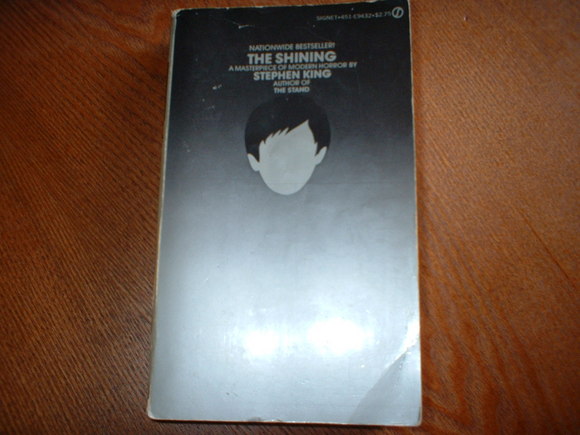
I probably don't need to tell you by now that The Shining scared me when I was younger.  However, it is a book with really only one major supernatural terror with the woman in Room 217 and a few more minor ones; the rest is more human.  I don't think I really understood the story beyond the horror when I was a kid, mostly just that the hotel was haunted and it was haunted with something bad.  That being said, it still was creepy.  Also, the copy that I remember had one of the creepiest covers I have ever seen on a book:

Yikes


The Shining is definitely a book that relies more on suspense than gore, unlike 'Salem's Lot, which, after a while, had plenty of overt scares.  But I think that the root of the plot hinges more on the individual characters than what is actually happening in the Overlook Hotel.  We have a writer who finds it difficult to control his urges, whether they pertain to alcohol or anger, but who also seeks to do better.  We have a wife who is remarkably dependent on her husband--maybe this was more typical in the 1970s, but I found it jarring that she really didn't seem to do anything other than raise their son.  And we have your average, mind-reading boy, whose telepathy is strong enough to reach from Colorado to Florida.  I would describe this novel as one in which King incorporates the supernatural to provide better insights into the natural: what we really see here is a father who gets pushed over the edge and cannot return.  While his being pushed over the edge is manifested by his being possessed by the evil hotel, the ending could work without any of the supernatural elements.

Also, he runs around for a while with a knife in his back.  Remember Carrie? 

I find King's writer characters particularly interesting in his books.  This could be because I need to write for my job, so I have an appreciation of how difficult that can be sometimes.  The first writer that we see working on a project is Ben Mears in 'Salem's Lot, although his actual writing seems to go pretty well.  There are several places where his process is described as relatively anguish-free since returning to the Lot.  Jack Torrence in The Shining is not as lucky.  At first, his writing goes well, which amplifies the other elements in his life and makes him satisfied.  As he begins to break down, his writing also goes with him.  I'm not sure if his writing block is symptomatic or the cause of his problems, but I do see the two as related.

The Shining is one of the books that has proven fertile for adaptations, including Kubrick's film and a Simpsons parody entitled 'The Shinning,' which was part of the fifth 'Treehouse of Horrors' specials.  I really like the Kubrick adaptation, even though it is not faithful to the novel.  Actually, I think that it is scarier than the novel and creates fantastic visual effects, plus adds a great final moment with the photograph.  The changes that Kubrick made are logical and fit with the idea of the book while creating a version that works on screen even if it differs from the book. 

'The Shinning,' on the other hand, was just plain funny.

Saturday, July 9, 2011

Carrie

Carrie was one of the few Stephen King books that I read when I was younger which did not scare me.  Not one bit.  Apparently angry telekinetics on the warpath with the ability to fry people via downed power lines was not terrifying.  But I think that probably it didn't scare me because this book is one of the easiest ones in which the story beyond the horror emerges.  Carrie is an ostracized, isolated teenager in what appears to be a very stratified high school--socially stratified high schools are definitely a recurring theme in Stephen King's books.  I think that those of us who felt ostracized have some sympathy for Carrie and maybe even a bit of Schadenfreude as she seeks revenge against the others.  That being said, she goes somewhat overboard, like blowing up large portions of the town.

I sometimes think of Stephen King's books as a commentary on earlier American fiction that created seemingly pastoral rural settings, like Thornton Wilder's Our Town.  In Grover's Corners, everything seems to be perfect, but it's actually not.  Death surrounds the play in a way that does not become fully apparent until the third act.  Books like Carrie are set in what should be idyllic towns but rather than masking the disturbing elements, as Wilder does, King brings them to the forefront.  In Carrie especially, the opening scene grounds the entire book since we see right away a girl who is detached from her social group, one who is the butt of jokes that are not funny, and the target of a group that comes close to a mob mentality.  There is also something here of Shirley Jackson, one of Stephen King's favorite writers, and the danger of crowds (like in 'The Lottery').  There is a similar moment when the bucket of pigs' blood hits Carrie: the whole crowd torments her with their frightened laughter, unsure of how to act when she is involved.

I liked the different techniques that King incorporated into this book.  There was his favorite interruption of text to insert the character's thoughts,

(Oh, how he likes to do this!)

which he returns to in a number of his other works.  In a book about someone with telekinetic powers, it works.  Also, I felt that the interspersion of fictional sources written later about the incident helped move along some of the plot without hindering it.  We didn't need anyone to walk in and explain details about Carrie's powers in an artificial way, we could just have an excerpt from an expert on telekinesis instead.  This technique will come back in other books, particularly since King enjoys creating lengthy histories for many of his stories (no, it's not just an out-of-control Dark Tower thing, although that is probably the best-known manifestation).  Actually, I suspect that part of what is driving me through this project is the idea that there are almost always hidden backgrounds in his books and I want to try and find them.

Carrie is actually a pretty compelling character.  I found it very effective at the end when she still wants her mother's help despite the fact that: a) her mother has never really helped her and b) her mother is dead.  But the idea that her actions go outside of her control and she wants help makes sense for her character; it also fits with the idea that she has been abused by her mother for her entire life and can't see how hurtful she was.  I think that this is part of why this book works: Carrie does what she can to integrate with her peer group, and we see her trying to assimilate, but in the end is unable to because of one vicious individual (Chris). 

One thing that I did not notice before: Stephen King has a thing, at least in these early books, for characters to walk around with weapons sticking out of them.  Specifically, Carrie walks around for a while with a knife sticking out of her back.  I can think of at least two other books in which this happens, but I won't give them away.  Need to leave some suspense.